Search

International Institute for Innovation in Governance

The Rise of the Food Risk Society

Economic development of transition and developed countries is associated with increasingly unhealthy dietary habits among low-income population segments. Drawing on Ulrich Beck’s sociological theory of risk society, the present research note calls attention to the positive relation between national economic development and food risks that result in the rise of food-related diseases and healthcare costs. On this basis, we argue that the knowledge-intensive agribusiness may translate Cochrane’s technological treadmill into Beck’s risk treadmill that shifts a growing share of food-related healthcare costs from producers toward consumers, state, and the healthcare system. This argument motivates a novel research program dealing with the “food risk treadmill” that emerges in response to modern farming and agribusiness practices. Awareness of the food risk treadmill may help to streamline the development of agricultural science and to prevent it from being excessively dominated by the agricultural and food industry.

Chatalova, L., Müller, D., Valentinov, V., & Balmann, A. (2016). The Rise of the Food Risk Society and the Changing Nature of the Technological Treadmill.Sustainability, 8(6), 584.

Evading spatial planning law

Spatial planning is a part of a general system of social and economic planning in Poland. Although it aims at promoting spatial order and sustainable development, it may sometimes stand in contradiction with the interests of various groups and players. The purpose of this paper is to discuss the ways of evading the planning law system by various actors in Poland. Recent examples are discussed and an assessment of the misused regulations is conducted. Case studies are followed by a general evaluation of the Polish legislative techniques and the planning system. To conclude, the paper outlines the most important recommendations for planners and urban officials to prepare more accurate and precise plans and acts of law in order to improve the legislative technique in spatial planning.

Wagner, M. (2016). Evading spatial planning law—Case study of poland. Land Use Policy, 57, 396-404.


The Politics of Environmental Knowledge

Researchers must be made accountable for academic impact on policy

Researchers want their knowledge to be useful and practical, in policy for example. But this means that they must be accountable for the choices they make. Quite wrongly, this is not considered to be part of researchers’ core business. Researchers should put more thought into what kinds of impact are worth pursuing and whose interest they serve and fail to serve in research. This was the basic message in the inaugural lecture delivered by Esther Turnhout during her installation as a professor holding a personal chair at Wageningen University on Thursday 2 June. The full lecture can be watched at: http://wurtv.wur.nl/p2gplayer/Player.aspx?id=bhqjAP

The choices made about what is to be researched and measured and how this will be done, affect the way in which certain problems are brought into the spotlight. Ecological research about nature, for example, is often based on scientific concepts such as species and habitats. As a result, policy tends to focus on protecting endangered species and their habitats. The term ecosystem services has become commonplace. The idea is that research should concentrate on the various services and functions of ecosystems, and that nature conservation must guarantee the sustainable production of these services. In other words, the choice between species or ecosystem services has implications for the way we see nature, what we consider important and how we need to protect it. So the choice of concept is actually political. “Nature conservation is far too important to leave choices like these to scientific researchers,” claimed the professor in her lecture The politics of environmental knowledge.

Which impact, and on whom?

Academic researchers want their knowledge to be put to good use and not simply filed away in a drawer. Science must have an impact. But researchers should think carefully about the type of impact they want to make, says Prof. Turnhout. “If they do not ask themselves this question time and time again, they are in danger of allowing their academic research to serve the interests of ongoing elites in policy and industry. The problems of marginalised actors in nature and society will simply be passed over.”

Dialogue

So it is important that academia takes responsibility for the choices it makes regarding which concepts they use and whose problems it decides to research. Conducting dialogue with non-academics is a good way of doing this. Current methods and ideas relating to this subject include citizen science and transdisciplinarity. The key is to ensure that non-academics are involved in the research throughout the process, from defining the problem and designing the research method, through to gathering and analysing the data. But in practice, academia still seems to be dominant, leading the way, controlling the facts and specifying the problems. On the whole, non-academics are merely recipients of scientific knowledge. “Although this constitutes a valuable step forward, it still doesn’t count as making yourself accountable,” says Esther Turnhout. Academics must create more room for exploring and maintaining contact with non-academics in order to fully understand the possible political implications of the choices they make.

Low Carbon Governance: Mobilizing Community Energy through Top-Down Support?

Community energy makes an important contribution to sustainable energy generation, reduction and management, and is a desirable feature of a low carbon future. Renewable community energy is increasingly gaining momentum even in the centralized UK energy market. The challenge of low carbon transitions is faced by multiple territorial governments, and requires inclusive governance arrangements in which a combination of actors work together to implement community strategies towards a climate-resilient future. Low carbon governance is a multi-level and (co-)evolving process, especially in the complex interactions between actors of the core, inner periphery and civil periphery. The devolution of power within the UK has enabled Scotland to establish an ambitious policy agenda for renewable energy. By exploring an established national community energy programme, this study examines the interplay among different actors and looks into how multi-level governance can be strengthened. This paper combines multi-level and evolutionary governance theory to understand the extent to which top-down initiatives facilitate community renewable energy projects and help drive wider system transformations. It concludes that in an evolving policy environment, top-down support for community energy is a necessary motivator. This requires the state to play a dominant role in directing low carbon transitions, while acting in concert with non-state, local and regional actors. If communities are to benefit from energy transitions, wider policies must be aligned with community needs, otherwise community energy will be pushed to the margins of the next energy revolution.

Markantoni, M. (2016). Low Carbon Governance: Mobilizing Community Energy through Top‐Down Support?. Environmental Policy and Governance, 26(3), 155-169.


Unpacking the politics of natural capital and economic metaphors in environmental policy discourse

$ $ $

Economic metaphors – including natural capital, natural assets, ecosystem services, and ecological debt – are becoming commonplace in environmental policy discourse. Proponents consider such terms provide a clearer idea of the ‘value’ of nature, and are useful for ensuring the environment is given due attention in decision making. Critical discourse analysis highlights the ideological work language does; the way in which we think, write, and talk about the environment has important implications for how it is governed. Consequently, the widespread use of economic metaphors is politically significant. This article discusses how metaphors have been analysed in environmental policy research, surveys the use of prominent economic metaphors in environmental policy, and considers the politics associated with such terms. The uptake of various economic metaphors represents a form of reverse discourse, varies in politically significant ways, and narrows the terms of environmental debate.

Coffey, B. (2016) Unpacking the politics of natural capital and economic metaphors in environmental policy discourse. Environmental Politics 25(2) 203-222.

Economisch of Land Degradation and Improvment

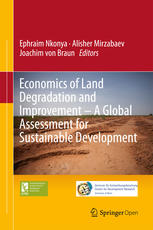
978-3-319-19168-3 A new book, edited by Ephraim Nkonya, Alisher Mirzabaev, and Joachim von Braun, deals with land degradation, which is occurring in almost all terrestrial biomes and agro-ecologies, in both low and high income countries and is stretching to about 30% of the total global land area. About three billion people reside in these degraded lands. However, the impact of land degradation is especially severe on livelihoods of the poor who heavily depend on natural resources. The annual global cost of land degradation due to land use and cover change (LUCC) and lower cropland and rangeland productivity is estimated to be about 300 billion USD. Sub-Saharan Africa (SSA) accounts for the largest share (22%) of the total global cost of land degradation. Only about 38% of the cost of land degradation due to LUCC – which accounts for 78% of the US$300 billion loss – is borne by land users and the remaining share (62%) is borne by consumers of ecosystem services off the farm. The results in this volume indicate that reversing land degradation trends makes both economic sense, and has multiple social and environmental benefits. On average, one US dollar investment into restoration of degraded land returns five US dollars. The findings of the country case studies call for increased investments into the rehabilitation and restoration of degraded lands, including through such institutional and policy measures as strengthening community participation for sustainable land management, enhancing government effectiveness and rule of law, improving access to markets and rural services, and securing land tenure. The assessment in this volume has been conducted at a time when there is an elevated interest in private land investments and when global efforts to achieve sustainable development objectives have intensified. In this regard, the results of this volume can contribute significantly to the ongoing policy debate and efforts to design strategies for achieving sustainable development goals and related efforts to address land degradation and halt biodiversity loss.

The book is open access and can be downloaded from the Springer website


International symposium on land consolidation

The Dutch Cadastre, in cooperation with the FIG, FAO and LANDNET, is organizing an international symposium on land consolidation and land readjustment for sustainable development.

The symposium will address the role of land consolidation and land readjustment in relation the great challenges in terms of food security for a growing world population and the need for sustainable development. It will give participants the opportunity to discuss strategies for sustainable development and designing resilient landscapes that meet the needs of society. The symposium will focus on four themes 1) Land administration, land consolidation and readjustment, 2) good governance, 3) sustainable development and 4)financial arrangements. Each of these themes can be addressed from a historical perspective, from current developments and from the expected needs in the future.

More information can be found on the website: http://www.lcsymposium.nl

Citizens, Leaders and the Common Good

Natural Resource Management is increasingly paying attention to participatory forms of governance, devolving authority and decision-making power to communities and community-based organizations. Scientific research on Natural Resource Management has been approached from a variety of theoretical perspectives. Many of these address the institutional arrangements that communities develop in order to manage natural resources. This focus on institutional evolution and design entails attention for the relations between people in and between different organizations. The shift to participatory forms of governance has placed even more emphasis on the political dimension of natural resource management and on issues such as institutional design, leadership, transparency, knowledge/ power and justice.  In this article we investigate the value and utility of Machiavelli’s work for Community-Based Natural Resource Management (CBNRM). Niccolo Machiavelli (1469-1527), the renaissance writer and self- professed founder of modern political theory, drew upon his own observations as a Florentine diplomat and the insights of ancient writers to investigate the ideal role of the citizen in governance. We argue that many of his insights offer valuable insights for the contemporary debates about community-based natural-resource management. We made a selection of five topics derived from literature on Natural Resource Management: (1) Law and Policy, (2) Justice, (3) Participation, (4) Transparency, and (5) Leadership and management. We use Machiavelli’s work to analyze these topics and embed the results in a narrative intended to lead into the final conclusions, where the overarching theme of natural resource management for the common good is considered. Machiavelli’s focus on practical realities produces new, sometimes unsettling, insights. We conclude that this focus helps to understand the development and performance of management regimes and their consequences and that institutional design should be seen as an ongoing process, which requires a constant adaptation of these institutions.

The paper is published in Ethics, Policy & Environment

It can also be downloaded from Researchgate:

Van Assche, K., R. Beunen & M. Duineveld  (2016) Citizens, leaders and the common good in a world of necessity and scarcity: Machiavellian lessons for Community-Based Natural Resource Management. Ethics, Policy & Environment 19 (1): 19-36.


Dealing with private property for public purposes

coverboekSanne

On the 6th of June, 2016 Sanne Holtslag-Broekhof successfully defended her PhD-thesis Dealing with prive property of public purposes. An interdisciplinary study of landtransactions from a micro-scale perspective.

Her thesis studies how public organizations deal with private land. During publicly initiated land transactions, central aspects for landowners are a good solution and a feeling of justice. Ideas on just land acquisition are diverse amongst owners and acquirers, but were related to lawfullness, decentness and equality. During land transactions landowners experience many uncertianties. Landowners deal with these uncertainties by creating expectations and act based on these expectations. The risk to end without replacing land, stops many owners from going to court for expropriation. Yet, a comparison between the last compensation offer during the voluntary negotiations and the final compensation in court shows that the final compensation ends on average 52% higher than the last compensation offer.
Since the economic crisis public parties aim for more facilitative land policy, but have often little experience to cooperate with private landowners. The insights of this research help public parties to deal more effective and lawful with private property during spatial developments.

Click here to download the full text of the book

The book includes the papers

Perceived (in)justice of public land acquisition

Understanding land transactions during land use change

Blog at WordPress.com.

Up ↑