Search

International Institute for Innovation in Governance

Tag

policy

Strategy for sustainability transitions

Always insightful, sometimes challenging, Strategy for Sustainability Transitions tackles global issues that have been piling up, from climate change to social inequality. The interdisciplinary approach of the authors is unique and inspiring. The crux of their argument is that the transition requires strategies underpinned by a comprehensive understanding of governance.’

– Fikret Berkes, University of Manitoba, Canada and author of Advanced Introduction to Resilience (Edward Elgar, 2023)

In this innovative work, Kristof Van Assche, Raoul Beunen and Monica Gruezmacher analyse the challenges and possibilities of sustainability transitions, presenting the dilemmas facing the path to more sustainable communities and societies, as well as proposing creative solutions. The authors deploy evolutionary governance theory as a conceptual framing for transition strategy, highlighting the importance of understanding governance and community strategy in any potential response to environmental crises.

This timely book expertly draws on a wide range of disciplines and theories, in considering the limitations imposed by unpredictable dynamics of power, discourse and affect and the shifting boundaries of what is governable. The authors demonstrate the creative potential of both instabilities and rigidities in governance. Chapters detail the basics of evolutionary governance theory, developing and applying it to transition strategy by engaging in an accessible manner with post-structuralism, psychoanalysis, institutional economics, systems theory and critical management studies. In a clearly constructed theoretical narrative, the results of this engagement become clear, in a new understanding of the weight of the past on governance and community, the construction of temporality, change and strategic change, contextual notions of good governance, and how these affect major shifts towards sustainability.

Strategy for Sustainability Transitions is an important addition to an ever-expanding and crucial field. Particularly relevant to practitioners and policy-makers interested in sustainable development and environmental governance, it will greatly appeal to students and scholars of human geography, public policy and administration, environmental politics and planning and development studies.

https://www.e-elgar.com/shop/gbp/strategy-for-sustainability-transitions-9781035323999.html

This excellent volume examines a key question of our time – the possibility of sustainability transitions – through an evolutionary governance lens. In addition to exploring how climate change, biodiversity and energy crises, water and food scarcity require societal transitions, it keeps a firm eye focused on the lessons that have been learned about why societal transitions occur (or not) and especially on the role played in these processes by governing institutions writ large. Drawing on earlier work by the authors and others in the field, the book introduces and applies the idea of a “governance path” in assessing how likely any sustainability transition might be and in what directions any such transition is likely to go. Concluding with a discussion of the interplay between governance and policy strategies, the book highlights the need for both good governance and good strategies if any kind of successful transition is to occur.’
– Michael Howlett, Simon Fraser University, Canada

Steering in Governance: evolutionary perspectives

Steering has negative connotations nowadays in many discussions on governance, policy, politics and planning. The associations with the modernist state project linger on. At the same time, a rethinking of what is possible by means of policy and planning, what is possible through governance, which forms of change and which pursuits of common goods still make sense, in an era of cynicism about steering yet also high steering expectations, seems eminently useful. Between laissez faire and blue-print planning are many paths which can be walked. In this thematic issue, we highlight the value of evolutionary understandings of governance and of governance in society, in order to grasp which self-transformations of governance systems are more likely than others and which governance tools and ideas stand a better chance than others in a particular context. We pay particular attention to Evolutionary Governance Theory (EGT) as a perspective on governance which delineates steering options as stemming from a set of co-evolutions in governance. Understanding steering options requires, for EGT, path mapping of unique governance paths, as well as context mapping, the external contexts relevant for the mode of reproduction of the governance system in case. A rethinking of steering in governance, through the lens of EGT, can shed a light on governance for innovation, sustainability transitions, new forms of participation and self-organization. For EGT, co-evolutions and dependencies, not only limit but also shape possibilities of steering, per path and per domain of governance and policy.

Table of Contents:

Steering in Governance: Evolutionary Perspectives
www.cogitatiopress.com/politicsandgovernance/article/view/4489
By Raoul Beunen and Kristof Van Assche

Steering as Path Creation: Leadership and the Art of Managing Dependencies and Reality Effects
www.cogitatiopress.com/politicsandgovernance/article/view/4027
By Kristof Van Assche, Martijn Duineveld, Monica Gruezmacher and Raoul Beunen

Economic Transitions in South Africa’s Secondary Cities: Governing Mine Closures
www.cogitatiopress.com/politicsandgovernance/article/view/4032
By Lochner Marais, Verna Nel, Kholisa Rani, Deidré van Rooyen, Kentse Sesele, Phia van der Watt and Lyndon du Plessis

Irritation Design: Updating Steering Theory in the Age of Governance
www.cogitatiopress.com/politicsandgovernance/article/view/4075
By Marc Mölders

Social Investment Policies in the EU: Actively Concrete or Passively Abstract?
www.cogitatiopress.com/politicsandgovernance/article/view/4079
By Gaby Umbach and Igor Tkalec

Strategy and Steering in Governance: The Changing Fates of the Argentine Planning Council
www.cogitatiopress.com/politicsandgovernance/article/view/4089
By Rodrigo Alves Rolo, Kristof Van Assche and Martijn Duineveld

What Is the Role of the Government in Wildlife Policy? Evolutionary Governance Perspective
www.cogitatiopress.com/politicsandgovernance/article/view/4106
By Krzysztof Niedziałkowski and Renata Putkowska-Smoter

Mitigating Pro-Poor Housing Failures: Access Theory and the Politics of Urban Governance
www.cogitatiopress.com/politicsandgovernance/article/view/4113
By Katja Mielke and Helena Cermeño

Policy Assemblages and Policy Resilience: Lessons for Non-Design from Evolutionary Governance Theory
www.cogitatiopress.com/politicsandgovernance/article/view/4170
By Kris Hartley and Michael Howlett

Environmental governance theories: a review

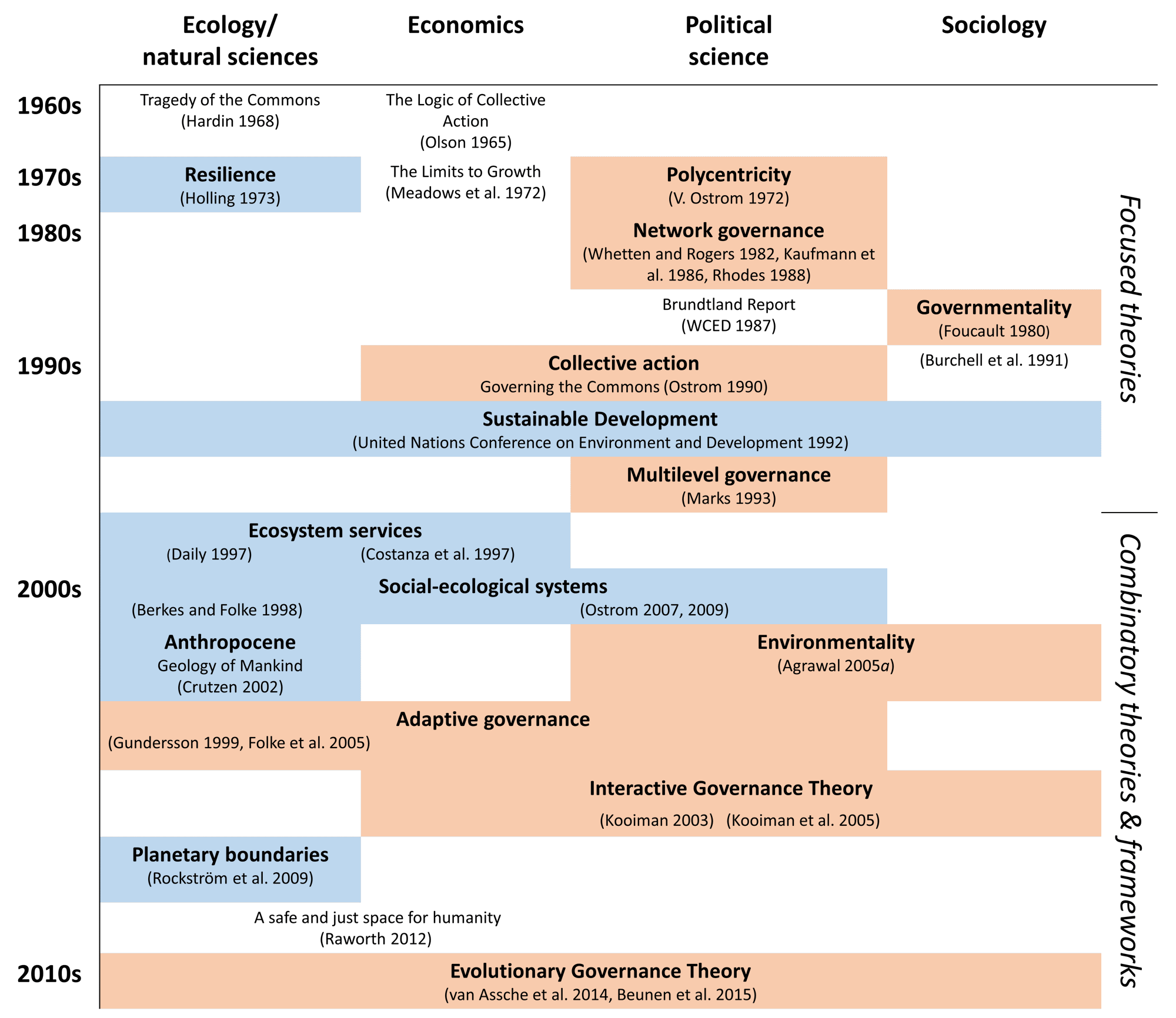
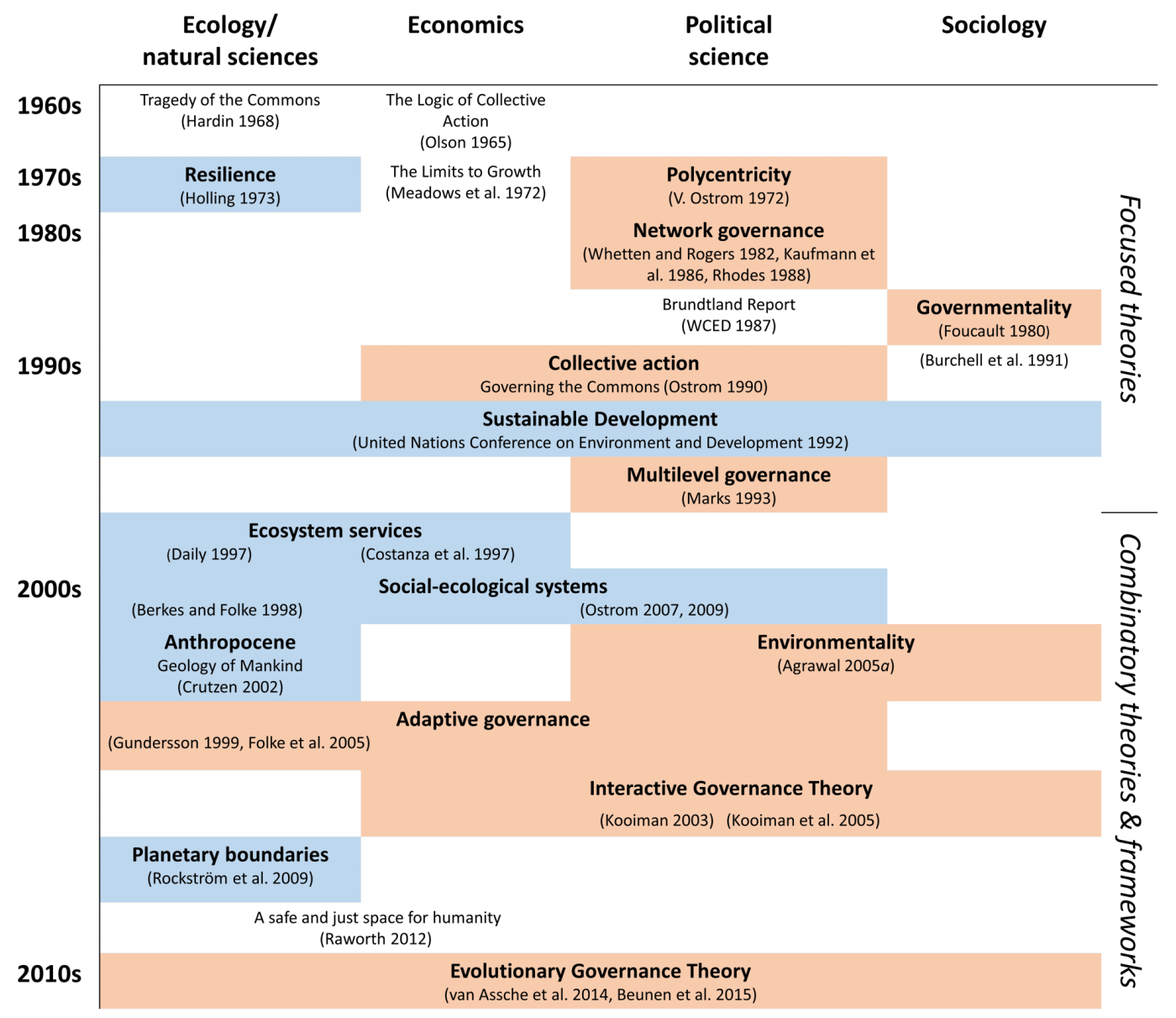
This article synthesizes and compares environmental governance theories. For each theory we outline its main tenets, claims, origin, and supporting literature. We then group the theories into focused versus combinatory frameworks for comparison. The analysis resonates with many types of ecosystems; however, to make it more tangible, we focus on coastal systems. First, we characterize coastal governance challenges and then later link salient research questions arising from these challenges to the theories that may be useful in answering them. Our discussion emphasizes the usefulness of having a diverse theoretical toolbox, and we argue that if governance analysts are more broadly informed about the theories available, they may more easily engage in open-minded interdisciplinary collaboration. The eight theories examined are the following: polycentricity, network governance, multilevel governance, collective action, governmentality (power / knowledge), adaptive governance, interactive governance theory (IGT), and evolutionary governance theory (EGT). Polycentricity and network governance both help examine the links or connections in governance processes. Polycentricity emphasizes structural configurations at a broader level, and network governance highlights agency and information flow within and between individuals or organizations. Collective action theory is helpful for examining community level governance, and helps analyze variables hindering or enabling self-organization and shared resource outcomes. In contrast, multilevel governance helps understand governance integration processes between localities, regions, and states across administrative, policy, or legal dimensions. Governmentality is helpful for understanding the role of discourse, power, knowledge, and narratives in governance, such as who creates them and who becomes governed by them with what effect. Adaptive governance helps analyze the links between context, change, and resilience. IGT helps examine the interdependencies between the systems being governed and the governing systems. EGT is helpful for unpacking how coevolutionary processes shape governance and the options for change.

Partelow, S., A. Schlüter, D. Armitage, M. Bavinck, K. Carlisle, R. Gruby, A.-K. Hornidge, M. Le Tissier, J. Pittman, A. M. Song, L. P. Sousa, N. Văidianu, and K. Van Assche. 2020. Environmental governance theories: a review and application to coastal systems. Ecology and Society 25(4):19.
https://doi.org/10.5751/ES-12067-250419

Mitigating boom & bust cycles: the roles of land policy and planning

A special issue of Land Use Policy, edited by Kristof Van Assche, Monica Gruezmacher, Leith Deacon

The focus of this special issue is on the struggle by communities in many parts of the world to manage radical ups and downs. The cycles of ‘boom and bust’ are diverse, transcending the often referenced dependency on a dominant resource, and many different responses can be observed.

The special issue presents a global collection of experts who have diverse experiences with, and perspectives on boom and bust. The articles emphasize land use tools (e.g. policies and plans) as means to mitigate the consequences of boom and bust on impacted stakeholders, communities, and regions. The articles present a wide variety of responses to boom and bust, some coordinated into strategy, others less so. In some cases, cycles are anticipated, in others, a community aims at reinvention after a dramatic downturn. 

Taming the boom and the bust? Land use tools for mitigating ups and downs in communities
Kristof Van Assche, Monica Gruezmacher, Leith Deacon

Land use tools for tempering boom and bust: Strategy and capacity building in governance
Kristof Van Assche, Monica Gruezmacher, Leith Deacon

Long run agricultural land expansion, booms and busts
Edward B. Barbier

Dealing with the bust in Vorkuta, Russia
Nikolay Shiklomanov, Dmitry Streletskiy, Luis Suter, Robert Orttung, Nadezhda Zamyatina

Mining towns and urban sprawl in South Africa
Lochner Marais, Stuart Denoon-Stevens, Jan Cloete

The social impact management plan as a tool for local planning: Case study: Mining in Northern Finland
Leena Suopajärvi, Anna Kantola

Evolutionary governance in mining: Boom and bust in peripheral communities in Sweden
Simon Haikola, Jonas Anshelm

Long distance commuting: A tool to mitigate the impacts of the resources industries boom and bust cycle?
Fiona Haslam McKenzie

Regional economic transformation: Changing land and resource access on the West Coast of New Zealand’s South Island
Etienne Nel, Sean Connelly

Planning strategies for dealing with population decline: Experiences from the Netherlands
Raoul Beunen, Marlies Meijer, Jasper de Vries

Problem-Based solutions from the classroom to the Community: Transformative approaches to mitigate the impacts of boom-and-bust in declining urban communities
Jesus J. Lara

Urban expansion, the politics of land, and occupation as infrastructure in Kinshasa
Filip De Boeck

Governance and the coastal condition: Towards new modes of observation, adaptation and integration

The conceptual framework of evolutionary governance theory (EGT) is deployed and extended to rethink the idea of coastal governance and the possibilities of a coastal governance better adapted to challenges of climate change and intensified use of both land and sea. ‘The coastal condition’ is analyzed as a situation where particular modes of observation and coordination were possible and necessary, and those observations (and derived calculations of risk and opportunity) are valuable for the governance of both land and an argument is constructed for a separate arena for coastal governance, without erasing the internal logic of pre-existing governance for land and sea. This entails that coastal governance is destined to be a place of (productive) conflict, as much as of policy integration. Policy integration will be more difficult and more important in coastal governance, as this is an arena where the effects of many land based activities and activities at sea become visible and entangled. Policy integration in coastal governance does however require deep knowledge of the governance path and existing forms of integration there (e.g. in planning), and it exists in an uneasy tension with the requirements of adaptive governance. This tension further contributes to the complexity and complex-prone character of coastal governance. Neither complexity nor conflict can be avoided, and coastal governance as an image of balanced decision- making is (positively) presented as a productive fiction.

Van Assche, K., Hornidge, A. K., Schlüter, A., & Vaidianu, N. (2019). Governance and the coastal condition: Towards new modes of observation, adaptation and integrationMarine Policy.


New book: Theory and applications

EGTIIThis new book in the series on Evolutionary Governance Theory (EGT) presents empirical studies and theoretical reflections on the most important concepts and their interrelations. Through this book we learn how communities understand themselves and their environment. Authors from different disciplines develop the EGT framework further and apply it to a wide range of governance issues covering topics such as welfare state governance, networks of power, climate change, water governance, natural resource management etc. The contributors reflect on the possibilities and limitations of steering, intervention, management and development in a world continuously in flux.

The book bridges the gap between more fundamental and philosophical accounts of the social sciences and applied studies, offering theoretical advancement as well as practical recommendations.

http://link.springer.com/book/10.1007%2F978-3-319-12274-8

Blog at WordPress.com.

Up ↑