Search

International Institute for Innovation in Governance

Trust related dynamics in contested land use

IMG_2733

De Vries, J.R., Aarts, N., Lokhorst, A.M., Beunen, R., Oude Munnink, J. (2014): Trust related dynamics in contested land use: A longitudinal study towards trust and distrust in intergroup conflicts in the Baviaanskloof, South Africa. Online first.

Using insights about in-group and intergroup dynamics from social identity theory and sociology, we studied trust dynamics in intergroup relations in the Baviaanskloof (South Africa) over time. We conclude that in-group interpretations of intergroup interactions contribute to the lack of trust and ongoing reconstruction of distrust towards the other group. Constructions of group identities and group history reinforce differences between groups, shaping expectations about the behaviour of in-group and out-group members. In this process, seemingly unrelated past events and contextual changes were connected as uncontested arguments as to why the other group could not be trusted. The lack of trust and growing distrust stabilised group dynamics and thus distrust towards the other group. These inter- and in-group dynamics explain why adapting to major environmental changes, and future collaboration becomes more difficult in conflict situations.

Spatial planning in cross-border regions: A systems-theoretical perspective

Joren Jacobs (2014) Spatial planning in cross-border regions: A systems-theory perspective. Planning Theory: online first

Most scholarship in spatial planning presupposes an established institutional setting, where a specific legal framework is in place, one is accustomed to certain procedures and routines, and planning has a certain (national) history. In cross-border regions, however, this becomes problematic as different institutional settings clash. Combining systems and organizational theory, this article constructs a theoretical perspective on planning, explicitly conceptualizing differences, that is, boundaries, in institutional settings. This sheds new light on the prospects and realities of spatial planning across national borders. National borders double the complexity of spatial planning, and organizations working in cross-border spatial planning need to take this into account by acknowledging their own and others’ organizational boundaries as well.

Absence/presence and the ontological politics of heritage: the case of Barrack 57

NEW ARTICLE
Absence/presence and the ontological politics of heritage: the case of Barrack 57 (online first)
Felder, M. ; Duineveld, Martijn ; Assche, Kristof van (2014) International Journal of Heritage Studies . – p. 16.

19 July 2009. A barn burns down in a small Dutch town. Afterwards, this invisible and insignificant ‘barn’ became widely known as ‘Barrack 57’. The destruction triggered attention and led to the barn’s association with a Nazi Second World War transit camp and with Anne Frank. Its material destruction made this barn/barrack both present and absent in various networks. We use the case of Barrack 57 to study the interplay between presence/absence and non-existence of objects in these networks, an exercise which connects to and contributes to the development of constructivist perspectives on object formation in heritage studies. Our analysis of presence/absence and non-existence therefore is based on different concepts developed in actor network theory and Niklas Luhmann’s theory of social systems. Of particular importance is Luhmann’s distinction between first- and second-order observation. We argue that heritage objects themselves are the result of different enactments of (non) human properties in various relational configurations. With this view, a new task for critical heritage scholars emerges. Understanding the dynamics of presence/absence and non-existence of heritage objects in different networks deepens insight into the broader issues of the formation of heritage objects and their delineating technologies and the policies of normalisation and naturalisation.

The adaptive capacity of Dutch planning


The 2014 conference of the Association of European Schools of Planning addresses the questions: ‘To what degree has planning theory, practice and education progressed from technocratic to co-evolutionary understandings and methods? And to what extent is planning finding new ways to engage with complexity, uncertainty and questions of accountability in the context of fragmented governance across institutional and territorial boundaries’.

In our contribution to this conference we will present Evolutionary Governance Theory as a framework for exploring the pathways of the Dutch planning system and its potential to adapt to a continuously-changing society. The Netherlands will be used to illustrate the evolution of planning and its adaptive capacity. Planning traditionally had a strong position within the Dutch state, but in recent years this position has become subject of debate. Within the last decade the planning organisations see their influence gradually decreasing. In various policy domains the previously dominant planning perspectives and practices become challenged and contested. Planning is often considered to face a crisis and both planning professionals and theorists are looking for novel ways to conceptualise and conduct planning.

Using the concepts of path, inter and goal dependency, we explore the possibilities and limitations for the planning system to embrace new ideas and to adapt to an always-changing society. We show that and how the recurring ideologies underlying planning tend to install overoptimistic expectations about the possibilities for science to understand socio-ecological systems, define problems, and design and implement solutions. As a consequence contemporary planning organisations, procedures, policies, plans, and practices are often strongly based upon the idea that they can be used to steer and control spatial developments. The performances of success hamper reflections and create blindspot for alternative ways of thinking. We conclude that the acceptance of complexity and non-linearity demand a planning system that embraces and enhances reflexivity and flexibility as important prerequisites for adaptation and innovation.

FREE EBOOK: GOVERNING BY CARROT AND STICK. A GENEALOGY OF THE INCENTIVE

American engineers first attempted to demarcate the ‘incentivizable subject’ as an object of knowledge and to design the techniques of power with which that subject could be governed. For them, the incentivization of employees was synonymous with the introduction of piece wages. From the 1920s onward, the authority of the engineers was challenged by management scientists who developed different explanations for employee behavior and developed a set of alternative techniques to increase productivity. The link forged between incentives and information by postwar economists makes for the third rationalization of government with the help of incentives. What is taken for granted in the use of the carrot and the stick as twin elements in these three successive programs for wielding power over people? PDF for free.

NEW ARTICLE

FORMAL/INFORMAL DIALECTICS AND THE SELF-TRANSFORMATION OF SPATIAL PLANNING SYSTEMS AN EXPLORATION

In this article, we present a perspective on the interaction between formal and informal institutions in spatial planning in which they transform each other continuously, in processes that can be described and analyzed as ongoing reinterpretations. The effects of configurations and dialectics are often ambiguous, only partially observable, different in different domains and at different times. By means of analyses of key concepts in planning theory and practice, this perspective is illustrated and developed. Finally, we analyze transformation options in planning systems, emphasizing the limits of formal institutions in transforming formal/informal configurations, and stressing the importance of judgment and conflict.

Interpretive Policy Analysis 2014 | Snacks Included


http://www.ipa2014.nl/ | http://www.ipa2014.nl/program_ipa

EGT IPA kopie

Book presentation: Evolutionary Governance Theory | Monday, December 9, 2013, 15:00 h. | Room C 63 of the Leeuwenborch building, Wageningen University

The challenges of contemporary societies demand new theoretical approaches that integrate social with environmental and life sciences. Evolutionary Governance Theory is a theoretical framework that adds new insights to now fashionable work on complex adaptive systems. During this meeting we will discuss novel ways to understand change and evolution in governance and how these can be used to design interventions that enhance the reflexive and adaptive capacities of governance.

IMG_8144

ABOUT THE BOOK: Evolutionary Governance Theory (EGT) is a novel perspective on the way markets, laws and societies evolve together. It can be of use to anyone interested in development, markets, public sector reform, public administration, politics and law. Drawing on a wide range of case studies on three continents and a variety of conceptual sources, the authors have developed a theory that clarifies the nature and functioning of dependencies that mark governance evolutions. EGT delineates in an entirely new manner the spaces open for policy experiment. As such, it offers a new mapping of the middle ground between libertarianism and social engineering. Theoretically, the approach draws on a wide array of sources: institutional and development economics, social systems theories, post-structuralism, actor- network theories, planning theory and legal studiesThe book can be downloaded here.

Van Assche, K. , Beunen, R., Duineveld, M. (2014) Evolutionary Governance Theory: An Introduction. Heidelberg: Springer.

ABOUT THE AUTHORS

Kristof Van Assche is interested in evolution and innovation in governance, with focus areas in development, environment, spatial planning and design. He is currently Visiting Associate Professor in Strategic Communication, Wageningen University, and Research Fellow at ZEF/ Center for Development Research, Bonn University. Teaching and research in various countries in Europe, North America, the Caucasus and Central Asia. His work is often comparative in nature, including a fieldwork component and theoretical reflections.

Raoul Beunen is researcher at the Strategic Communication Group of Wageningen University. He works on Evolutionary Governance Theory in the fields of natural resource management and spatial planning. His research explores the potentials and limitations of environmental policy and planning in the perspective of adaptive governance and sustainability. He studies the implementation of planning and environmental policies in different institutional settings and investigates the importance of path dependence in enabling new perspectives in policy landscapes.

Martijn Duineveld is Assistant Professor Cultural Geography at Wageningen University, The Netherlands. He works on Evolutionary Governance Theory in the fields of geography and urban planning. He is especially interested in the dynamics of power, knowledge and places. He teaches in courses on human geography, research methods, cultural geography, empowerment, sustainability, landscape architecture and planning. He is active in both academic and societal debates on citizenship, governance and democratisation.

The importance of reflexivity in planning and design education

FREE PUBLICATION: The importance of reflexivity in planning and design education
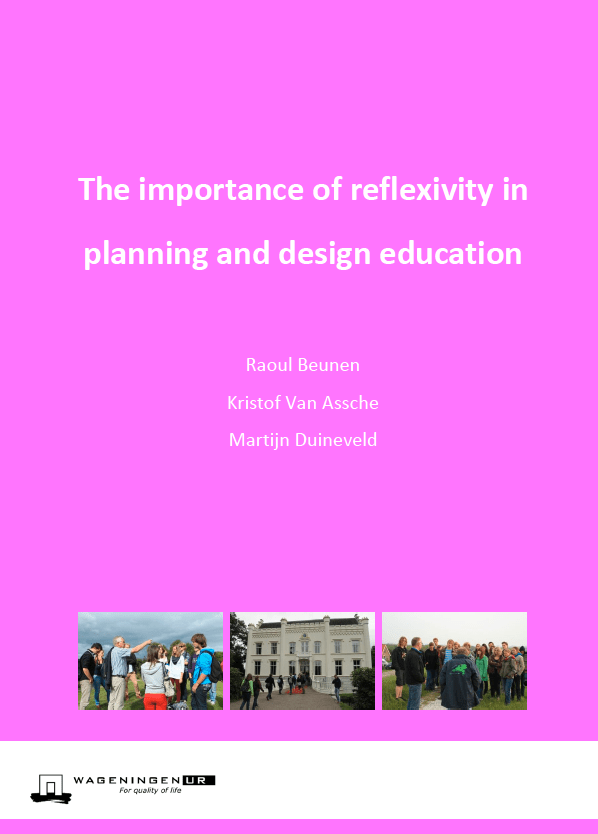
Schermafbeelding 2013-10-21 om 14.59.52

This is a special edition of a Wageningen University Working Papers in Evolutionary Governance Theory (EGT).

Education in planning and design, as a broad field of related disciplines and professions, like land-scape architecture, spatial planning, urban planning and design, and environmental governance en-compasses scientific and practical dimensions (Van Assche et al., 2013, Goldstein and Carmin, 2006; Friedmann, 1996). Most of the educational programs in Europe and the United States focus on train-ing students aiming to actually work in planning and design practices. Yet, the nature of those prac-tices and by extension those of the related disciplines, has been questioned continuously (Sandercock, 1997). In landscape architecture, there is the eternal debate on design, at the cross-roads of art and science (Van Assche et al., 2013, Gunder, 2011, Bannister, 1947, Hunt, 2002, Swaffield, 2002, Blake, 1999). In planning the quest for rational steering and control have become object of severe criticism (Van Assche and Verschraegen, 2008, Allmendinger, 2002, Flyvbjerg, 1998, Gunder and Hillier, 2010, Beunen et al., 2009). These issues are reflected in the development and organization of curricula. Each planning or design program can be interpreted as a set of negotiated positions in on-going debates on the nature of planning and design and a perspective on the role of these disciplines in society.

The past decades brought major changes in planning and design practices as well as in the sci-entific reflection on these practices (Van Assche et al., 2014). There is overall tendency in which planning and design processes are organized with more attention to participation and deliberation (Bevir, 2004; Beunen and Opdam, 2011; Mannigel, 2008; Fischer, 2009; Van Assche et al., 2011b). These shifts in governance are strongly intertwined with the contemporary debates about the role of science and expertise in society and the shift noticeable here (Beunen et al., 2012; Herrnstein-Smith, 2005 Fischer, 2000; McNie, 2007; Ellis and Waterton, 2005; Duineveld, 2008). Within the planning and design disciplines, the positivist belief in objective, value free knowledge enabling governmental actors to steer spatial organization, is gradually replaced by approaches in which planning and design processes and practices themselves have become objects of scientific investigation (Van Assche et al., 2012b; Flyvbjerg and Richardson, 2002; Flyvbjerg, 2002; Hillier, 2002; Allmendinger, 2001; Fischer, 2000; Duineveld et al., 2013; Nowotny et al., 2001). These changes bring along particular challenges for those who have to formulate curricula and courses in these disciplines. They should find ways to accommodate the new insights, and try to envision the consequences for the training of future practitioners. The reasons to change curricula are not limited to profession and discipline- specific transitions. One of the most important challenges is that curricula increasingly need to meet standardized academic criteria, without getting totally detached from planning and design practice (cf. Keeling, 2006; Lock and Lorenz, 2007).

We argue that planning and design cannot tackle these issues without a deeper and more sys-tematic self-reflection, a reflection on the disciplines, their teaching approaches, and on the role of planners and designers in society. In this paper we will show how research and outreach can play a transformative role in the development and delivery of planning and design curricula. Education, we argue, can be a primary site of rejuvenation of the disciplines. In order to confront the issues at hand, the disciplines will have to rethink a number of relationships, and reflexivity can be a powerful tool in this endeavour. A stronger focus on reflexivity in planning and design education is desirable be-cause this can contribute to the sharper delineation of art, science, and mere accepted practice. Reflexivity, in other words, we deem essential in a remaking of planning and design, that can in-crease the innovative capacity and adaptive potential of both disciplines and professions.

Blog at WordPress.com.

Up ↑