Search

International Institute for Innovation in Governance

Local Cosmopolitanism. Imagining and (Re-) Making Privileged Places

IMG_8862

This book offers a unique perspective on cosmopolitanism, examining  the ways it is constructed and reconstructed on the small scale in an ongoing process of matching the local with the global, a process entailing mutual transformation. Based on a wide range of literatures and a series of case studies, it analyzes the different versions and functions of cosmopolitanism and points to the need to critically re-examine current conceptions of globalization.

The book first illustrates the interplay between networks and narratives in the construction of cosmopolitan communities in three specific cities: Trieste, Odessa and Tbilisi. Each has a past more cosmopolitan than the present and each uses that cosmopolitan past to guide them towards the future.

Next, the book focuses on narrative dynamics by isolating several discourses on the cosmopolitan place and figure in European cultural history. It then goes on to detail the internal representations and local functions of larger wholes in smaller communities, shedding a new light on issues of inter- disciplinary interest: self- governance, participation, local knowledge, social memory, scale, planning and development.

Of interest to political scientists, anthropologists, economists, geographers and philosophers, this book offers an insightful contribution to theories of globalization and global/ local interaction, bringing the local discursive mechanics into sharper focus and also emphasizing the semi- autonomous character of narrative constructions of self and community in a larger world.

http://link.springer.com/book/10.1007/978-3-319-19030-3

Understanding social ecological change through palm use and management

Wednesday 11 March Monica Gruezmacher successfully defended her PhD thesis “Understanding social ecological change through palm use and management“.

prommonica

As people change their livelihood preferences, they change the way they relate to the natural resources around them. Anticipating and managing these changes, where possible, is a major challenge for sustainable land-use planning and natural resource management. This is most evident in the Amazon, a region of immense biological and cultural diversity but also a region of rapid change and transformation, quickly integrating through transportation infrastructure (roads, harbors, airports, etc.) with other South American regions and the rest of the world. In her PhD thesis Monica Gruezmacher analyzes social and ecological change taking place in indigenous settlements of the Amazon region, as they transform their subsistence economies to fit into a western model of living. She uses social ecological systems as a framework to identify and explore the linkages between changes in these two domains, and aims at understanding natural resource management from the perspective of the user and the utilized resource. This requires an understanding of collective decision making (governance) of the variations in land and resource use in a community governed in a specific way, and of the response of forests to small-scale human intervention. The way decisions are taken and the way a group of people structure their governance system will affect the ecological system in different ways. Her thesis elaborates on the fast transformation and diversification of formerly indigenous communities and fast-track integration into western systems of organization resulting in hybrid governance systems with different combinations of traditional and western ways of social organization and resource management.

Changes in the management of three utilized palm species served as indicators of change in the social ecological system. Palms are not sown from seed or transplanted into cultivation areas rather they are passively cultivated (protected from fire, weeds, pests, falling branches, etc.). Changes in palm management betrayed a general shift from a view of cultivation areas as the community’s pantry to a view of cultivation areas as the sum of individually owned plots where only commercially valued species are harvested. The distinction between the three zones was blurred in the community with greater access to the west, there was a pressure towards privatization, to erase the traditional zoning regulations, since both palms and land are seen as a commodity. Indiscriminate extraction is taking place in forested areas and in cultivation areas pressure and conflicts are increasing and leading to formalization of property rights and new forms of representation, thus pushing integration further. Transportation infrastructure will continue its expansion, the pressure for oil and mineral extraction will increase in the Amazon and it will be necessary to accept and understand these paths of change in order to minimize the negative consequences that they might have for the social ecological system as a whole.

New book on rural development

rural development

The topic of rural development has received attention from a wide range of disciplines and professions. Many books and articles have been written, presenting success stories, critical reflections, and very detailed guidelines on how to realize development.

In a new book on rural development Kristof Van Assche and Anna-Katharina Hornidge bring together these different insights and discuss the most influential perspectives and renders their risks and benefits visible. They put forward a novel integrative perspective on rural development drawing on Evolutionary Governance Theory. Paying particular attention to the various roles of knowledge, Van Assche and Hornidge offer useful insights in the multiple discourses on development and the changing ways in which these are embedded in governance. Drawing on the experiences in five different continents they show that discourses, institutions, actors, are constantly co-evolving and they offer the reader the conceptual tools to understand how things are organized now, which development path has already been taken, and how things could possibly move in a different direction.

The book is available from Wageningen Academic Press

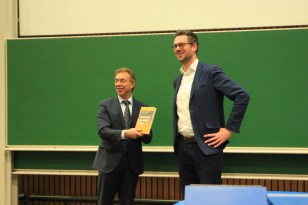
EGT book presented to rector magnificus of Wageningen UR

EGTbookpresentation

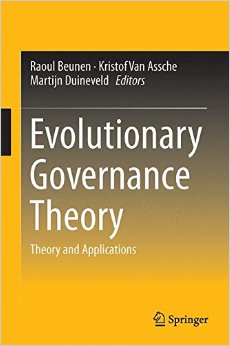
During a symposium on learning in communities, the first copy of a new book on Evolutionary Governance Theory was presented to Prof. dr. Kropff, rector magnificus of Wageningen University and Research centre. This book puts forward a novel framework for furthering our understanding of the embedding of different forms of knowledge in governance and the rapidly changing position of science in society. Evolutionary Governance Theory (EGT) is helpful for analyzing the production, enactment and application of knowledge and the various roles of social learning in these processes. The book presents empirical studies and theoretical reflections that are partly based on transdisciplinary research projects, such as those carried out in the Science Shop of Wageningen UR.

New book: Theory and applications

EGTIIThis new book in the series on Evolutionary Governance Theory (EGT) presents empirical studies and theoretical reflections on the most important concepts and their interrelations. Through this book we learn how communities understand themselves and their environment. Authors from different disciplines develop the EGT framework further and apply it to a wide range of governance issues covering topics such as welfare state governance, networks of power, climate change, water governance, natural resource management etc. The contributors reflect on the possibilities and limitations of steering, intervention, management and development in a world continuously in flux.

The book bridges the gap between more fundamental and philosophical accounts of the social sciences and applied studies, offering theoretical advancement as well as practical recommendations.

http://link.springer.com/book/10.1007%2F978-3-319-12274-8

The evolution of socio-ecological systems

thatch san martin

This article investigates natural resource governance in three indigenous communities in the Colombian Amazon. We base our analysis on an evolutionary governance model in which governance dimensions emerge as relevant through time. The less accessible of the communities represents earlier steps in governance evolution, while the more physically accessible is more integrated into the western scene. We observe how increased physical accessibility in a community brings in western governance models which hybridize with more traditional ones, influencing the couplings between the social and ecological systems. We zoom in on changing management of three commonly used palm species and illustrate how detailed studies of natural resource management contribute to understanding governance evolution. By comparing governance evolutions we were able to gain insights and improve our understanding on how natural resource management changes in communities transiting into western ways of living. In doing so we recognized points of rigidity and flexibility which might influence the social ecological systems capacity to adapt to changing conditions.

Gruezmacher, M. & Van Assche, K. (2014) The evolution of socio-ecological systems: changing palm species management in the Colombian Amazon as an indicator of ecological and institutional change. Journal of Environmental Planning and Management.

Understanding Trust

Understand Trust

Trust plays an important role in governance processes. It enables people to take risks, to deal with uncertainties, and it facilitates cooperation. Despite its important only few studies explore how trust develops and evolves. Jasper de Vries has picked up this challenge and studied trust dynamics from a longitudinal perspective. He developed and explored different perspectives on trust and applied these in various case studies. Comparing these cases allowed him to develop a novel and well elaborated perspective on trust dynamics. The insights and ideas put forward in his book offer interesting starting points for further studies towards the importance, development and effects of trust between people, groups and organizations in governance and economics.

Download the book Understanding Trust: Longitudinal studies on trust dynamics in governance interactions

Power and contingency in planning

IMG_5409

Kristof Van Assche, Martijn Duineveld, Raoul Beunen

Abstract. In this paper we analyse the role and reception of poststructuralist perspectives on power in planning since the 1990s, and then ask whether a renewed encounter with the works of poststructuralist theorists Foucault, Deleuze, and Luhmann could add something to the points that were already made. We make a distinction between the power of planning (the impact in society), power in planning (relations between players active in planning), and power on planning (the influence of broader society on the planning system), to refine the analysis of planning/power. It is argued that an interpretation of Deleuze, Luhmann, and Foucault, as thinkers of power in a theoretical framework that is based on the idea of contingency, can help to refine the analysis of power in planning. Planning then can be regarded as a system in other systems, with roles, values, procedures, and materialities in constant transformation, with the results of each operation serving as input for the next one. The different power relations constitute the possibilities, the forms, and the potential impact of planning.

Keywords: power, contingency, acting space, governance, evolution

Environment and Planning A: http://www.envplan.com/abstract.cgi?id=a130080p

For wur-library users: http://www.envplan.com.ezproxy.library.wur.nl/abstract.cgi?id=a130080p

WASS PhD course | Mon 15 December 2014 | Governance theories and governance frameworks: tailoring, matching and making them work for YOU

WASS PhD course:  Governance theories and governance frameworks: tailoring, matching and making them work for YOU

Choosing and understanding a theory on governance for your Phd project is not an easy endeavour. Governance is a broad issue that is addressed, analysed, and understood in diverging ways. The literature on governance has a long tradition, that includes literature as old as Artistoteles and Machiavelli, and that has embraces disciplines ranging from public administration, planning, policy sciences, to economics. This course will give you an overview of these different theories and their interrelations.

Based on this overview of governance theories we will help you to reflect about your own theoretical framework. We will discuss its strengths and weaknesses, the internal compatibility of the theory you have chosen and the potential relations with and embeddings of other theories.

In the second part of the course particular attention will be given to more recent theoretical developments in which more and more attention is given to the evolutionary nature of governance. This part will focus on Evolutionary Governance Theory (EGT). EGT is a novel theory of governance in which governance is conceptualized as radically evolutionary, which implies that all elements of governance are subject to evolution, that these elements co- evolve, and that many of them are the product of governance itself. The theory puts forward a new framework in which concepts and ideas from various sources such as post-structuralism, discourse theory, social systems theory, and institutional and development economics are embedded.

During this part of the course the overall structure of EGT and its core concepts will be presented and explained. Particular attention will be given to the ways in which this framework can help to enrich and deepen your own theoretical framework. The course will offer plenty of opportunities to discuss your empirical findings, your theoretical ideas and if you are interested you can also discuss your (draft) papers and to get feedback on the possibilities to refine the analysis and put forward a comprehensive and coherent story.

http://www.wageningenur.nl/en/Expertise-Services/Chair-groups/Environmental-Sciences/Cultural-Geography-Group/Show-1/WASS-PhD-course-Governance-theories-and-governance-frameworks.htm

Blog at WordPress.com.

Up ↑