Search

International Institute for Innovation in Governance

Symposium on learning and innovation in resilient systems

Resilience has become a fashionable buzzword in recent years. The term is frequently found in many different discourses ranging from nature conservation (WWF’s adaptation and resilience program), sports psychology (teaching athletes about resilience), to development work (resilience in rural areas). It appears that everything (cities, companies, software) and everybody (managers, children, teachers) can and should be resilient. With our current knowledge of future challenges like climate change, globalisation and food security resilience can offer a way to develop strategies to cope with uncertainties.

The Dutch Open University organises a 2-days symposium on learning and innovations in resilient systems, on 23rd and 24th March 2017, in Heerlen, the Netherlands. The symposium offers an unique opportunity to discuss these topics, in an interdisciplinary environment. Focusing on (i) information and computer systems, (ii) organizational and management systems, and (iii) environmental systems.

We invite scientists from all disciplines to debate how and to what extent innovations and learning processes in various systems contribute to the transition towards (more) resilient systems, be it individuals, organisations, et cetera. We welcome theoretical papers, methodological papers, and empirical studies or combinations thereof; and invite abstracts that discuss and examine innovations and learning for resilience from various angles.

We are delighted that we can announce the following keynote speakers that will contribute to the symposium:

  • Prof. Dr. Ir. Carl Folke, Stockholm Resilience Centre and the Royal Swedish Academy of Sciences
  • Prof. Dr. Ir. Petra de Weerd-Nederhof, University of Twente
  • Prof. Dr. Ir. Yasmin Merali, University of Hull
  • Prof. Dr. Ir. Bart Jacobs, Radboud University Nijmegen

Practicalities and submission deadlines:

Interested participants/authors are encouraged to submit 250 word abstracts by 15th October 2016 as a first step towards full paper development. Please send your abstract to program.resilient2017@ou.nl.

Authors will be notified of acceptance/rejection by 15th December 2016; contributing authors are expected to submit a full first draft of their paper by 1st February 2017.

Finally, more information can be found on our website:

https://www.ou.nl/web/learning-and-innovations-in-resilient-systems

Exploring the governance and politics of transformations towards sustainability

The notion of ‘transformations towards sustainability’ takes an increasingly central position in global sustainability research and policy discourse in recent years. Governance and politics are central to understanding and analysing transformations towards sustainability. However, despite receiving growing attention in recent years, the governance and politics aspects of transformations remain arguably under-developed in the global sustainability literature. A variety of conceptual approaches have been developed to understand and analyse societal transition or transformation processes, including: socio-technical transitions, social-ecological systems, sustainability pathways, and transformative adaptation. This paper critically surveys these four approaches, and reflects on them through the lens of the Earth System Governance framework (Biermann et al., 2009). This contributes to appreciating existing insights on transformations, and to identifying key research challenges and opportunities. Overall, the paper brings together diverse perspectives, that have so far remained largely fragmented, in order to strengthen the foundation for future research on transformations towards sustainability.

Patterson, J., Schulz, K., Vervoort, J., van der Hel, S., Widerberg, O., Adler, C., … & Barau, A. (2016). Exploring the governance and politics of transformations towards sustainability. Environmental Innovation and Societal Transitions.

Managing ups and downs in communities

Boom and Bust: A guide for managing ups and downs in communities is the result of a collective effort at the University of Alberta to better understand the dramatic ups and downs which too often characterize western Canadian communities. It offers community leaders, politicians, administrators, academics, students, and all active citizens helpful techniques to analyze the current state of their own community, understand how it got where it is today, and ultimately, identify possible ways forward. We encourage analysis of historical paths and policy contexts to better understand what strategies might work (or not) in a community.

The authors encourage readers to learn from local histories, a broad range of tested theories, and the experiences of other communities to develop a context-sensitive strategy of asset building, while at the same time taking on an informed understanding of what assets and resources could support long-term development planning for their communities. They demonstrate that assets become such within a context and within a narrative, forming a story about the past, present, and future of the community.

By showing the importance of reinvention and the dangers of rigid identity, the authors call on communities to re-evaluate their assets and their dependencies, and ultimately to reintroduce long-term perspectives within governance.
By acknowledging the difficulty of local control over local development in a global economy, the guide offers strategies to broaden perspectives and inspire local action, as well as to harness the power of informal relations, latent stories, silent assets, and diverse local identities to cultivate more varied and prosperous futures.

Read more about the book at the website of the University of Alberta or read the free online version of the guide via ISSUU.

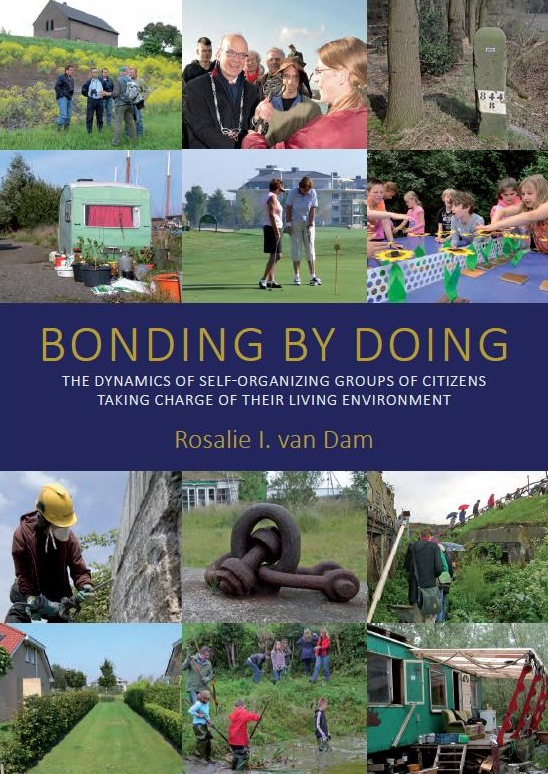
Bonding by doing : the dynamics of self-organizing groups of citizens taking charge of their living environment

The role of citizens’initiatives in governance is changing, therewith changing governance. This thesis studies groups of citizens following their ideals and taking charge of their living environment. Citizens’ initiatives and self-organizing communities, are seen as groups of people, who organize themselves, are active in the public domain, creating public values  and who organize and manage their social, cultural and green living environment. The actuality of self-organizing citizens gives rise to investigating its actual practice: people’s reasons to get involved, their activities, their meaning for place and vice versa, their strategies, their (informal) organisation, their development, their relations to others, etc. Besides investigating how citizens’ initiatives and self-organizing communities develop and realize themselves, the research concerns the implications for governance processes and the role and approach of citizens and governmental organizations in these processes.

Van Dam, R.I. (2017) Bonding by doing: The dynamics of self-organizing groups of citizens taking charge of their living environment. Wageningen University and Research, Wageningen.

Transforming energy systems by transforming power relations

Energy transitions bring about changes in the infrastructural energy system and in the social sphere. Crucially, these changes touch upon power relations. Thus, studying the social order through the perspective of the energy system should include an understanding of “power”. Dispositive thinking and governmentality studies are two promising approaches for conceptualizing power relations. Whereas dispositive thinking is important for understanding powerful and strategic socio-material configurations, the concept of governmentality provides a framework for the analysis of how and why individuals adopt certain subject positions in the face of technologies of power. The value of the two approaches is illustrated with an empirical case study from the German Energiewende: renewable energy development in north-western Brandenburg. The paper concludes by comparing the relative strengths and weaknesses of dispositive thinking and governmentality studies and by discussing how further research on the role of power in energy systems can be conceptualized.

Gailing, L. (2016). Transforming energy systems by transforming power relations. Insights from dispositive thinking and governmentality studies. Innovation: The European Journal of Social Science Research, 1-19.

Tourism Destination Evolution

This book offers a novel, evolutionary, perspective on the dynamimcs of tourism and tourism destinations. It brings together different authors and experiences from all over the world. It reflects on well-known concepts such as the Tourism Area Life Cycle, and introduces new ones. Doing so it offers new ways of looking at tourism dynamics and interesting new approaches for analyzing and explaining the way in which the tourism sector co-evolves with other societal domains.

Brouder, P., Clavé, S. A., Gill, A., & Ioannides, D. (Eds.). (2016). Tourism Destination Evolution. Routledge.

The hidden truth behind EU ‘green energy’

Sustainability objects as performative definitions of sustainability

This article introduces the notion of sustainability objects as a label for objects that come with a claim of promoting a more sustainable mode of living. The purpose is to show that organizations that develop such objects construct a performative definition of sustainability. A case study of the development of a facility for the pre-treatment of food-waste-based biogas and biofertilizers serves as an empirical example of the development of sustainability objects. The analysis demonstrates that this development and concomitant defining of sustainability have involved the contextualizing of biogas and biofertilizers, entangling them in nets of relationships and endowing them with an agency of their own. With sustainability objects embodying definitions of sustainability, their success or failure as objects derive from the success or failure of the performative definitions that they embody, and vice versa. Asking why sustainability objects gain or lose ground is therefore suggested as a way of understanding the character and evolution of sustainability transition.

Corvellec, H. (2016). Sustainability objects as performative definitions of sustainability: The case of food-waste-based biogas and biofertilizers. Journal of Material Culture, 1359183516632281.

Configuring Urban Carbon Governance

In the political geography of responses to climate change, and the governance of carbon more specifically, the urban has emerged as a strategic site. Although it is recognized that urban carbon governance occurs through diverse programs and projects—involving multiple actors and working through multiple sites, mechanisms, objects, and subjects—surprisingly little attention has been paid to the actual processes through which these diverse elements are drawn together and held together in the exercise of governing. These processes—termed configuration—remain underspecified. This article explores urban carbon governance interventions as relational configurations, excavating how their diverse elements—human, institutional, representational, and material—are assembled, drawn into relation, and held together in the exercise of governing. Through an analysis of two contrasting case studies of urban carbon governance interventions in Sydney, Australia, we draw out common processes of configuring and specific sets of devices and techniques that gather, align, and maintain the relations between actors and elements that constitute intervention projects. We conclude by reflecting on the implications of conceiving of governing projects as relational configurations for how we understand the nature and practice of urban carbon governance, especially by revealing the diverse modes of power at work within processes of configuring.

McGuirk, P. M., Bulkeley, H., & Dowling, R. (2016). Configuring Urban Carbon Governance: Insights from Sydney, Australia. Annals of the American Association of Geographers, 106(1), 145-166.


Blog at WordPress.com.

Up ↑