
Economic development of transition and developed countries is associated with increasingly unhealthy dietary habits among low-income population segments. Drawing on Ulrich Beck’s sociological theory of risk society, the present research note calls attention to the positive relation between national economic development and food risks that result in the rise of food-related diseases and healthcare costs. On this basis, we argue that the knowledge-intensive agribusiness may translate Cochrane’s technological treadmill into Beck’s risk treadmill that shifts a growing share of food-related healthcare costs from producers toward consumers, state, and the healthcare system. This argument motivates a novel research program dealing with the “food risk treadmill” that emerges in response to modern farming and agribusiness practices. Awareness of the food risk treadmill may help to streamline the development of agricultural science and to prevent it from being excessively dominated by the agricultural and food industry.
Chatalova, L., Müller, D., Valentinov, V., & Balmann, A. (2016). The Rise of the Food Risk Society and the Changing Nature of the Technological Treadmill.Sustainability, 8(6), 584.
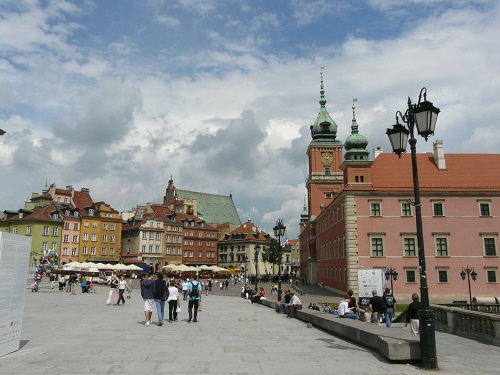
Spatial planning is a part of a general system of social and economic planning in Poland. Although it aims at promoting spatial order and sustainable development, it may sometimes stand in contradiction with the interests of various groups and players. The purpose of this paper is to discuss the ways of evading the planning law system by various actors in Poland. Recent examples are discussed and an assessment of the misused regulations is conducted. Case studies are followed by a general evaluation of the Polish legislative techniques and the planning system. To conclude, the paper outlines the most important recommendations for planners and urban officials to prepare more accurate and precise plans and acts of law in order to improve the legislative technique in spatial planning.
Wagner, M. (2016). Evading spatial planning law—Case study of poland. Land Use Policy, 57, 396-404.
$ $ $
Economic metaphors – including natural capital, natural assets, ecosystem services, and ecological debt – are becoming commonplace in environmental policy discourse. Proponents consider such terms provide a clearer idea of the ‘value’ of nature, and are useful for ensuring the environment is given due attention in decision making. Critical discourse analysis highlights the ideological work language does; the way in which we think, write, and talk about the environment has important implications for how it is governed. Consequently, the widespread use of economic metaphors is politically significant. This article discusses how metaphors have been analysed in environmental policy research, surveys the use of prominent economic metaphors in environmental policy, and considers the politics associated with such terms. The uptake of various economic metaphors represents a form of reverse discourse, varies in politically significant ways, and narrows the terms of environmental debate.
Coffey, B. (2016) Unpacking the politics of natural capital and economic metaphors in environmental policy discourse. Environmental Politics 25(2) 203-222.
 This paper explores the role of place branding, specifically at the regional scale, as an instrument for the attainment of strategic spatial planning goals. It aims to contribute to the academic debate on place branding by discussing its relevance and effectiveness in supporting economic and social spatial realignment through civic participation and the shaping of clearly envisioned agreed futures.
Exploratory in nature, this paper’s theoretical exploration is developed by detailing relevant findings from a case study on the significance of a regional branding initiative, integrated in a wider planning strategy for northern Portugal (NUTS II). In conducting this exploratory research, primary data were gathered through 16 in-depth, semi structured interviews with key-regional actors and organizations with a stake (and expertise) in the region.
Findings show the key-strategic domains in which the region excels. These domains could fuel a potential regional branding initiative. However, the key regional actors interviewed agree that the diverse and fragmented regional assets and the socio-economic scenario all require and yet hinder regional coordination efforts. In addition, territorial reorganization and the definition of a regional economic model, plus decentralization of decision-making and the establishment of leadership, are imperative for the effectiveness of a regional branding strategy aligned with the ongoing strategic spatial planning initiatives.
Managerial implications of integrating the opinions and perspectives of regional actors into a potential place branding initiative as strategic spatial planning instrument include improving socio-spatial and spatial-economic condition of the region and envisioning shared futures.
By guiding the thoughts of scholars, practitioners and policy-makers towards a strategic spatial planning approach to place branding, the paper contributes to the advancement and maturation of the place-branding field, by lending a more strategic approach and geographical/spatial consciousness to the process of place branding. The paper also sheds light on the challenges and complexity of branding regions, a scale of analysis seldom explored in place branding literature.
Oliveira,E. (2016) Place branding as a strategic spatial planning instrument: a theoretical framework to branding regions with references to northern Portugal. Journal of Place Management and Development 9 (1) online first.

We develop a social systems theory perspective on Central Asian post-Socialist transition, placing particular emphasis on the coordination problems in transboundary water governance. The extensive Soviet water-energy infrastructure around the Amudarya and Syrdarya rivers required coordination, but this could no longer be politically secured after the 1991 Soviet disintegration. According to the social systems theory of Niklas Luhmann, coordination problems are generally endemic to any modern regime of functional differentiation. We show that each Central Asia state had to tackle substantial internal adaptation problems, which were rendered even more formidable by the need for transboundary coordination. We further demonstrate how the new riparian states offer a complex picture of several forms of differentiation, where functional differentiation is in some ways reinforced by the new national boundaries and the collapse of Soviet planning. We identify possible sources of flexibility, opening up avenues toward adaptation and enhanced coordination across boundaries.
Nodir Djanibekov, Kristof Van Assche & Vladislav Valentinov (2015) Water Governance in Central Asia: A Luhmannian Perspective. Society & Natural Resources: An International Journal. Online first: http://dx.doi.org/10.1080/08941920.2015.1086460

The fourth edition of Readings in Planning Theory brings together the essential classic and cutting-edge readings in planning theory. It introduces and defines key debates in planning theory with editorial materials and readings selected both for their accessibility and importance The book is edited by Susan Fainstein and James DeFilippis.
“This 4th edition is the best-available compendium and analysis of planning theory. Remarkably, the editors manage to retain many of the foundational readings while also producing a volume that is overwhelmingly grounded in new scholarship. This expands the canon to show how theory can be inspired and produced by practitioners and scholars engaged with far more than the United States and Europe” (Lawrence J. Vale, Massachusetts Institute of Technology)
Part of book the are available via googlebooks

Raoul Beunen, Albert Aalvanger, Martijn Duineveld and Kristof Van Assche
During the IPA 2015 conference in Lille we presented a conceptual framework for understanding the evolution of local governance. Using this framework we reflect on the processes of changes in different places in the Netherlands and delineate a number of topics that have so far gained limited attention in the debates about innovation in local governance.
The attention of innovation in local governance has increased in the last years, with many actors, including national and local governments, civil society organizations, researchers, and individual citizens, advocating change. Although the motivations and assumption underlying their pleas can largely diverge, there is a strong consensus about the need to adapt institutional arrangements to fit the challenges of the 21th century. Many arguments focus on strengthening the legitimacy and inclusiveness of local governance, on improving the effectiveness of delivering public goods and services, or a combination of both. The search for new forms of local governance is given extra weight due to the budget cuts that many governments need to make. With less resources available these governments are forced to revise and delimit their role in public affairs and social welfare, something which might erode the possibilities and legitimacy of existing institutional arrangements.
Although the growing attention for innovation in local governance seems to be a recent phenomenon, we should not forget that governance has always been changing. Over time institutional frameworks need to be adjusted, to evolving internal and external conditions. One can think of the necessary adjustment of institutional frameworks to emerging societal issues or changing economic circumstances. The set of institutions designed to stabilize a community, will never perfectly fit internal and external environments at the same time, and its evolution will never be fully in sync with changes in the environment. Furthermore, even if the need to adjust institutions is observed by citizens and leadership, not every redesign is possible.
We use Evolutionary Governance Theory to understand the position and outcomes of recent attempts for innovation in local governance as part of a wider governance path. This helps delineating the possibilities and limitation for innovation. Drawing on a wide range of case studies in the Netherlands we explore how initiatives for innovation in local governance affect citizen’s and government’s views and motivations, their strategizing, their negotiations about shifting roles and responsibilities and the ways in which these are reflected in institutional frameworks.

Recent developments in local governance in the Netherlands show that the quest for novel forms of local governance might not always be successful. Pleas for novelty can in fact delimit or prevent real innovation and reduce the potential of civil society to pick up new tasks and responsibilities. Pushing for innovation can have negative consequences when it lacks a more substantial, contextualized perspective on problems and possible alternatives, and is merely looking for something new because it is new or if it is pushed by organisations whose role in the new arrangements will be limited.
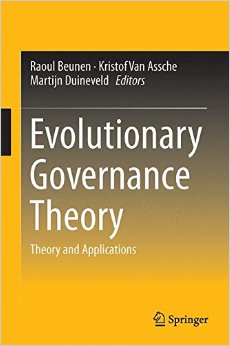 This new book in the series on Evolutionary Governance Theory (EGT) presents empirical studies and theoretical reflections on the most important concepts and their interrelations. Through this book we learn how communities understand themselves and their environment. Authors from different disciplines develop the EGT framework further and apply it to a wide range of governance issues covering topics such as welfare state governance, networks of power, climate change, water governance, natural resource management etc. The contributors reflect on the possibilities and limitations of steering, intervention, management and development in a world continuously in flux.
The book bridges the gap between more fundamental and philosophical accounts of the social sciences and applied studies, offering theoretical advancement as well as practical recommendations.
 International Institute for Innovation in Governance