Search

International Institute for Innovation in Governance

Author

M

M

Politics of policy learning

In Dutch healthcare, new market mechanisms have been introduced on an experimental basis in an attempt to contain costs and improve quality. Informed by a constructivist approach, we demonstrate that such experiments are not neutral testing grounds. Drawing from semi-structured interviews and policy texts, we reconstruct an experiment on free pricing in dental care that turned into a critical example of market failure, influencing developments in other sectors. Our analysis, however, shows that (1) different market logics and (2) different experimental logics were reproduced simultaneously during the course of the experiment. We furthermore reveal how (3) evaluation and political life influenced which logics were reproduced and became taken as thelessons learned. We use these insights to discuss the role of evaluation in learning from policy experimentation and close with four questions that evaluators could ask to better understand what is learned from policy experiments, how, and why.

Felder, M., van de Bovenkamp, H., & de Bont, A. (2018). Politics of policy learning: Evaluating an experiment on free pricing arrangements in Dutch dental careEvaluation24(1), 6-25.

Call for papers: Spatial planning & place branding: rethinking synergies and governance

In a special issue for European Planning Studies we intend to bring together experts on spatial planning and place branding to think explicitly on the relation between the two fields and the potential of  theories and practices in which the two are integrated.

We believe exploring the relation between spatial planning and place branding is useful and important because, on the one hand, the relation is still under- explored, while planning could use the insights in place-based value creation stemming from place branding, and place branding often lacks insight in how places might actually be changed or preserved through coordinated intervention. On the other hand, much of the literature on place branding in our view either under- estimates or over- estimates what branding can do, partly because of underlying ideological assumptions, partly because of simply a lack of insight in the functioning of governance, including spatial governance.

Bringing planning and branding closer together in theory and practice means seeing their relation in the context of governance. Planning in this view is spatial governance, the coordination of policies and practices affecting the organization of space. Place branding refers to the creation of value in space by reinforcing and representing the assets of the place in a cohesive manner, in an image and a narrative of the place itself.

Given this context various topics could be explored in this special issue:

  • planning and branding and participatory governance
  • planning and branding and sustainable development
  • planning/branding and the balance preservation/innovation
  • spatial planning as part of place branding
  • place branding as part of spatial planning?
  • planning/branding as core of a development strategy?
  • nature and environmental assets in planning/branding
  • cultural landscapes as meta- assets for planning/branding
  • planning/branding and policy integration
  • innovation and branding
  • design in planning/branding
  • power/knowledge in planning/branding
  • scales in governance/ multi- level governance
  • combining planning/branding for places with deep history
  • agriculture and new food cultures as drivers of planning/branding
  • planning/branding and the balance between collaboration and competition
  • models of branding or planning: caution with best practices

If you are interested in making a contribution to the special issue, please send an abstract of 300-500 words to the guest editors by Feb 15, 2018; for those invited to submit a full paper, please submit this to the guest editors by August 1, 2018; after an internal review and revision, the usual external review for the journal will take place.

Kristof Van Assche, Raoul Beunen and Eduardo Oliveira

emails

Call for papers: land use instruments

The Journal Land Use Policy is organizing a special  issue on land use instruments to mitigate radical shifts or boom and bust cycles in communities. The special issue will include papers from well-known universities and research institutes in the United States, Indonesia, Canada, Australia and the Netherlands, among others, and is currently looking to expand the breadth of topics and geographical areas in order to have a genuinely comparative approach.

The special issue starts from a broad understanding of land use tools that includes all those institutional tools that affect the coordination of land use. Various sorts of planning, zoning, economic development strategies, preservation policies, etc. can have the character of land use policy tool if they aim at the coordination of land use and the reorganization of land. They can include and activate more circumscribed and focused land use tools.

The cases presented in this special issue are expected to highlight the diverse ways communities have confronted the radical changes associated with boom and bust and the lessons learned to try to mitigate them.

If you are interested you can participate by sending a 300 word abstract to Monica Gruezmacher (gruezmac[at]ualberta[dot]ca) by December 30th this year. 

Via this you will find a short explanatory document with details on the content, process and approach.

Institutions and Urban Space

This paper develops an historical institutionalist approach to municipal governance, infrastructure, and property institutions, suggesting that the dense matrices of institutions in cities are co-evolutionary and path dependent. Property, infrastructure, and governance institutions play a central role in regulating capital investment in cities, structure urban change, protect and structure property’s meaning and value, and demonstrate enduringly different approaches between jurisdictions. The institutions in place when land is urbanized have profound impacts on the institutionalization and forms of urban property and the accompanying infrastructure created. The primary positive feedback that contributes to path dependence in cities flows from existing sets of property in any given jurisdiction. Cities from this perspective are path dependent landscapes of property that are differentiated primarily by the enduring imprint of the institutions that produce them.

Sorensen, A. (2017). Institutions and Urban Space: Land, Infrastructure, and Governance in the Production of Urban PropertyPlanning Theory & Practice, 1-18.

Community power and institutional dependence in the renewable energy sector

The speed and progress of transitions towards renewable energy systems varies greatly between European member states. Among others, these differences have been attributed to the emergence of grassroots initiatives (GIs) that develop radical ideas and sustainable practices. The goal of this paper is to understand the differences in the emergence of GIs for renewable energy in relation to the institutional characteristics of Denmark, the Netherlands and Sweden. We analyze the possibilities of GIs to emerge and act within three dimensions: the material-economic, the actor-institutional and discursive dimension. We conclude that conditional factors lie within the material-economic dimension in terms of the biophysical conditions, the structure of the economy, energy dependency and the energy market. Within the actor-institutional dimension, we conclude that the presence or absence of fossil fuel incumbents, such as regional utilities, strongly influence the possibilities of GIs. Within the discursive dimension, openness for alternative discourses proved to be enabling for GI-activities, as well as democratized knowledge production. In addition to these conditions of possibility, GIs can also act despite dominant institutions, albeit limited. Finally, GIs need a strong network with knowledge institutes, technology developers and political parties in order to achieve institutional change that enables GIs to flourish. Without institutional space, GIs remain subjected to the dominant power-relations, and cannot exert much influence upon the energy system.

Henk-Jan Kooij, Marieke Oteman, Sietske Veenman, Karl Sperling, Dick Magnusson, Jenny Palm, Frede Hvelplund (2017) Between grassroots and treetops: Community power and institutional dependence in the renewable energy sector in Denmark, Sweden and the Netherlands. Energy Research & Social Science, 37: 52–64

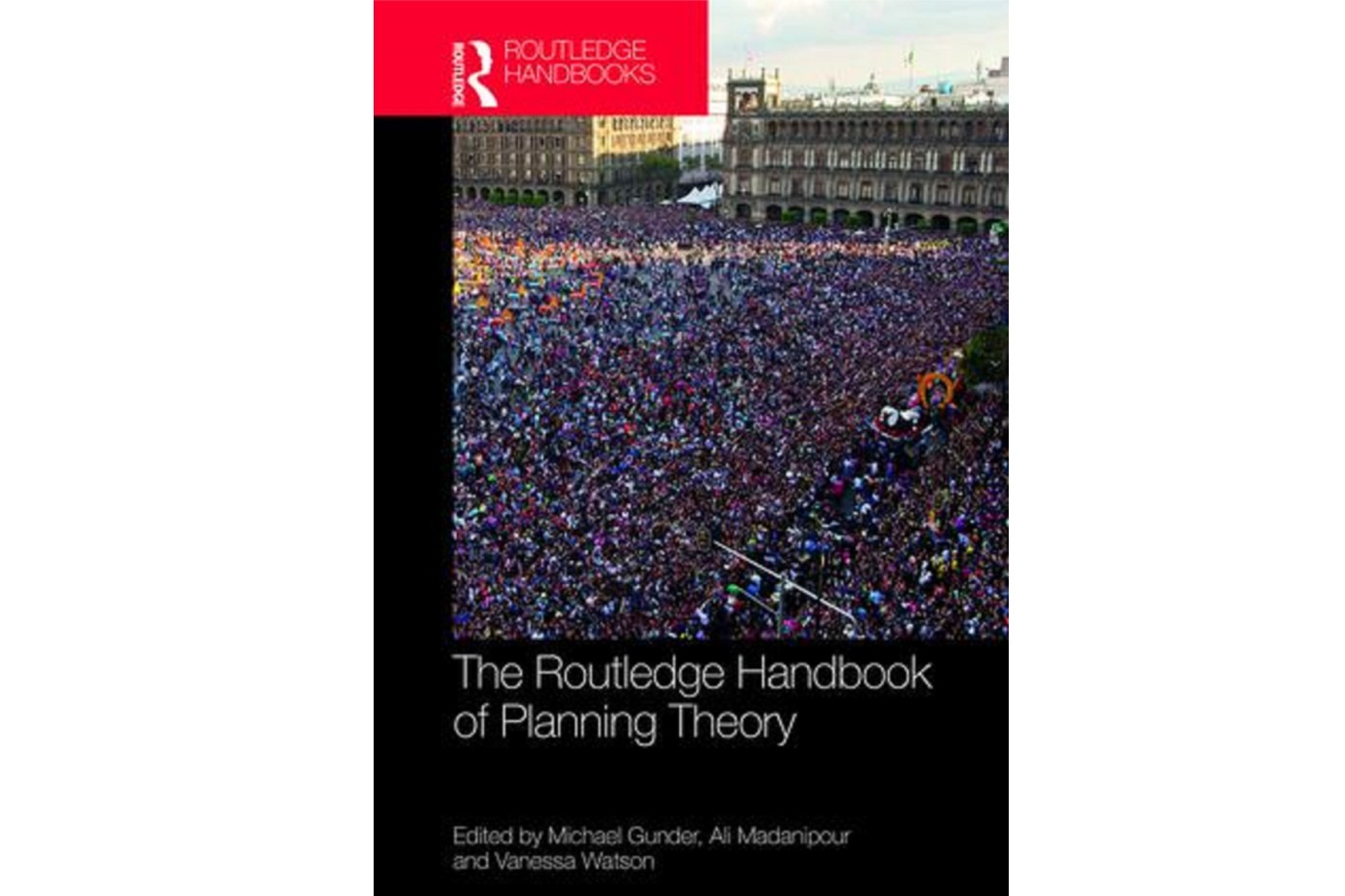
Evolutionary Governance Theory enters the Canon of Planning Theory

‘From Habermas and Lefebvre to Rancière and Mouffe this handbook captures the zeitgeist of planning theory with contributions from some of the most innovative thinkers in their fields.’ Professor Phil Allmendinger

In a changing and often unpredictable globalized world, planning theory is core to understanding how planning and its practices both function and evolve. As illustrated in The Routledge Handbook of Planning Theory, planning and its many roles have changed profoundly over the recent decades; so have the theories, both critical and explanatory, about its practices, values and knowledges. The handbook presents key contemporary themes in planning theory through the views of some of the most innovative thinkers in planning.

The Routledge Handbook of Planning Theory includes a chapter on Evolutionary Governance Theory. The chapter analyses the presence, the origins and the potential of co- evolutionary perspectives in planning theory. It pays particular attention to Evolutionary Governance Theory, as a comprehensive perspective on co- evolution in spatial planning and governance. The co- evolutionary approach to planning presents a middle ground between (social) engineering approaches on the one hand and theories completely disqualifying planning and steering on the other. Both ends of the spectrum have often been criticized for respectively overestimating the steering possibilities of governments and the organizing capacities of markets. Planning theory embedded in governance theory can help to analyse and understand a particular governance context, to delineate the possibilities and limits of planning in that context, and to determine which planning efforts are most likely to have a positive impact. In a co-evolutionary perspective, context as such, and governance context in particular, are never fixed, never stable: all elements and structures are continuously influencing each other.

The co-evolutionary perspective as developed in EGT opens up planning theory for a series of relevant concepts from different disciplines, relevant for the analysis of current and potential forms of planning in a community, while conversely giving theories and practices of planning a firm place within governance. The chapter shows how a co-evolutionary perspective is a very useful lens for both analysis and change, for the development of new planning perspectives or for the deliberate circumvention of a current planning system.

Power/knowledge and natural resource management: imagining, creating and protecting the commons

This special issue of Journal of Environmental Policy & Planning draws the attention to ongoing concerns about the management of natural resources (NRM): their exploration, extraction, processing, and commodification is still happening in ways that are perceived to be socially unjust and ecologically unsustainable. The special issue seeks to highlight how the Foucaultian notion of power/knowledge remains underused and underdeveloped in the realm of environmental and resource governance. The contributors argue that any improvement in NRM to social justice or sustainability will have to pass through the knot of power/knowledge. Revealing the actual functioning and effects of current NRM opens potential for critical thinking, shifts power relations and questions the core assumptions of experts or economic outcomes.

Content of the special issue:


Power/Knowledge in Natural Resource Management

Editorial
The will to knowledge: natural resource management and power/knowledge dynamics
Kristof Van Assche, Raoul Beunen & Martijn Duineveld

Article
Partnerships for development in the extractive sector: protecting subterranean interests?
Javier Arellano-Yanguas & María del Pilar Bernal-Gómez

Partnerships for Development (PfD) is the antidote that extractive industries have used over the last decade to counteract the proliferation of conflicts with local communities. Normatively, the concept of ‘partnership’ positions companies as actors on an equal footing with others in their attempts to collaborate to achieve development outcomes. This article analyses how the PfD strategy has been crafted and implemented in the extractive sector and assess its potential to contribute significantly to local development. Using the Foucauldian framework on power/knowledge and genealogy, we explain how, in a relatively short time, the interaction between context, preexisting discourses, and actors’ interests shaped the PfD discourse and made it famous. The second part of the paper goes beyond the normative conceptualisation and analyses the implementation of PfD through the case studies of the Antamina copper mine in Peru and the Pacific Rubiales oil operation in Colombia. The companies use the PfD discourse to advance their interest vis-à-vis the different stakeholders, minimising the risk of conflicts and cultivating their reputation. These companies resort to the fragmentation of bargaining spaces and rely on the legitimacy provided by paid experts. The result is that PfD has limited capacity to promote local sustainable development.

Article
Small-scale fisheries within maritime spatial planning: knowledge integration and power
Svein Jentoft

The coasts hold great potential for ‘Blue Growth’, and major industrial and infrastructural developments are already happening there. Such growth, however, comes with risks to marine ecosystems and coastal communities. Competition for space and resources intensifies, turning the coast into an area of social and political conflict, including contestation about knowledge. I argue that there is a need for institutional innovation that allows knowledge integration and conflict resolution to be more interactive and synergistic. The paper critically analyses discourses and practices of interactive governance and co-management while visiting Foucault’s power/knowledge concept for investigating the normativity and effects of participation discourses and practices. This is followed by a discussion of multiple governance paths and their different combinations of resources and forms of expert and local social and ecological knowledge so as to see how they can help resolve conflicts, and enhance governability within maritime spatial planning (MSP) in a way that also serves to create a level playing field for all stakeholders. A particular focus will be on the small-scale fisheries sector, which is the lest powerful stakeholder and the most vulnerable to external pressures. Will MSP help to empower or further marginalize small-scale fishers and fisheries communities?

Article
Natural capital and the political economy of wetland governance in Alberta
Marian Weber, Naomi Krogman, Lee Foote & Rebecca Rooney

The legitimacy of wetland decisions depends on how science and values are integrated and reflected in wetland management decisions. Natural capital and ecosystem services (ES) have become integral to how we think about ecosystem management however there is no consensus on how these concepts should be applied in management. Through the example of Alberta’s wetland policy, we show how policies designed to mainstream natural capital and ES in decision-making are aligned with liberal governance arrangements that emerged in the nineteenth century. There is a governance gap between individual wetland decisions and collective ecological outcomes. The Alberta wetland policy highlights three challenges to embracing the natural capital metaphor in a liberal government context: lack of consensus on policy objectives; case by case enforcement of policy leading to continued wetland drainage; and minimal consequences for non-compliance. The combination of norms about what is fair in terms of government intervention in land use decisions and scientific uncertainty about wetland ecosystem function makes it difficult to achieve consensus on limits to wetland loss contributing to continued loss of wetland ecological function. The discussion highlights the necessity of renewed political discourse about freedom, power, and justice in relation to collective economic and ecological security.

Article
Governing the water user: experiences from Mexico|
Edwin Rap & Philippus Wester

This article traces a policy shift that makes the ‘water user’ the main subject of water governance. From a Foucauldian perspective on governmentality these new subjectivities accompany neo-liberal governmental technologies to devolve autonomy from state institutions to an active user base, whilst retaining some ‘control at a distance’. The expectation is that individual subjects will incorporate control mechanisms and internalize norms and that this leads to new publicly auditable forms of self-regulation. The article questions the underlying assumption that policy necessarily accomplishes its strategic effects through governmentality. For this purpose, it draws on an ethnographic case study of how policy produced a new power/knowledge regime and how different societal actors and ‘user’ groups responded to that. The study specifically investigates the Mexican policy of irrigation management transfer during the 1990s, by which government transferred the public control over irrigation districts to locally organized water users’ associations (WUAs). The article argues that governmental technologies make and govern the ‘water user’ by discursively and materially constituting an organizational arrangement for user management (WUA), more than by directly acting on individuals’ self-regulated conduct. The analysis contributes to a broader reflection on the role of power/knowledge in natural resources management and decentralized resources governance.

Article
Power/knowledge and natural resource management: Foucaultian foundations in the analysis of adaptive governance
Kristof Van Assche, Raoul Beunen , Martijn Duineveld & Monica Gruezmacher

In this paper, we present a conceptual framework extending Foucaultian insights on the relations between power and knowledge to link up with current insights into studies of natural resource management (NRM) and more broadly environmental studies. We classify discourses in NRM according to understandings of social–ecological systems and argue that grasping those larger contexts can push NRM in a different direction, forming a base for more informed and inclusive decision-making. We then reconstruct the importance of materiality, the physical world, for the functioning of NRM within social–ecological systems. The concept of livelihoods is added to our developing Foucaultian frame, as material/discursive entwinements which structure responses of many stakeholders in NRM. Finally, we present an expansion of Foucaultian NRM into adaptive governance thinking as a logical outcome of basic insights into power/knowledge, developed and contextualized in current NRM and its critical analyses.

Article
Materiality in natural resource management: a systems theory view
Vladislav Valentinov

This short paper is a commentary on Van Assche et al.’s article [(2017). Power/knowledge and natural resource management: Foucaultian foundations in the analysis of adaptive governance. Journal of Environmental Policy and Planning, this issue]. A Luhmannian systems-theoretic perspective proposed in this commentary reaffirms the Foucaultian conceptualization of natural resource management as a site for the interaction of discourses constituting social reality through radical entwinements with materiality, with livelihoods being a key example of such entwinements. Several extensions of Duineveld et al.’s argument are proposed. First, the Luhmannian perspective stresses the problematic nature of such entwinements in view of the inherent system–environment adaptation problems. Second, the idea of livelihoods advocated by the authors is interpreted as the reflection of the sensitivity to the environment beyond the limits imposed by the systemic operational closure and complexity reduction. Third, it is argued that even though specific discursive constructions of materiality may underpin adaptive governance with respect to specific environmental segments, they cannot guarantee system–environment adaptation in any general sense, primarily in view of the unknowability of the environment and the incommensurability of discourses.

Power/knowledge and natural resource management: Foucaultian foundations in the analysis of adaptive governance

In this paper, we present a conceptual framework extending Foucaultian insights on the relations between power and knowledge to link up with current insights into studies of natural resource management (NRM) and more broadly environmental studies. We classify discourses in NRM according to understandings of social–ecological systems and argue that grasping those larger contexts can push NRM in a different direction, forming a base for more informed and inclusive decision-making. We then reconstruct the importance of materiality, the physical world, for the functioning of NRM within social–ecological systems. The concept of livelihoods is added to our developing Foucaultian frame, as material/discursive entwinements which structure responses of many stakeholders in NRM. Finally, we present an expansion of Foucaultian NRM into adaptive governance thinking as a logical outcome of basic insights into power/knowledge, developed and contextualized in current NRM and its critical analyses. Download: here

New book chapter in: Key Thinkers on Cities

New book chapter on Flyvbjerg by Martijn Duineveld, Kristof Van Assche and Raoul Beunen in: Key Thinkers on Cities (Regan Koch – Queen Mary University of London & Alan Latham – University College London)

Key Thinkers on Cities provides an engaging introduction to the dynamic intellectual field of urban studies. It profiles the work of 40 innovative thinkers who represent the broad reach of contemporary urban scholarship and whose ideas have shaped the way cities around the world are understood, researched, debated, and acted upon. Providing a synoptic overview that spans a wide range of academic and professional disciplines, theoretical perspectives and methodological approaches, the entry for each key thinker comprises:

  • A succinct introduction and overview
  • Intellectual biography and research focus
  • An explication of key ideas
  • Contributions to urban studies

The book offers a fresh look at well-known thinkers who have been foundational to urban scholarship, including Jane Jacobs, Henri Lefebvre, Manuel Castells, and David Harvey. It also incorporates those who have helped to bring a concern for cities to more widespread audiences, such as Jan Gehl, Mike Davis, and Enrique Peñalosa. Notably, the book also includes a range of thinkers who have more recently begun to shape the study of cities through engagements with art, architecture, computer modelling, ethnography, public health, post-colonial theory, and more.

With an introduction that provides a mapping of the current transdisciplinary field, and individual entries by those currently involved in cutting edge urban research in the Global North and South, this book promises to be an essential text for anyone interested in the study of cities and urban life. It will be of use to those in the fields of anthropology, economics, geography, sociology, and urban planning. https://us.sagepub.com/en-us/nam/key-thinkers-on-the-city/book244138

Blog at WordPress.com.

Up ↑